Does Hot Water Actually Sanitize Laundry
Hot water has long been associated with hygiene. Many laundry habits assume that higher temperatures automatically make fabrics safer, cleaner, or sanitized. In household laundry systems, that assumption does not hold up the way most people expect.
Sanitizing is a defined process. Cleaning is a different one. Odor control is another. These outcomes overlap, but they are not interchangeable.
What sanitize means in everyday laundry use
In a household context, sanitizing refers to reducing microorganisms to a level considered acceptable for daily use. It does not mean eliminating everything, and it does not mean making fabrics sterile.
Sanitization depends on three conditions occurring together:
- A specific temperature threshold
- Sustained exposure at that temperature
- Consistent contact across the entire surface being washed
If any of those conditions are not met, the process shifts away from sanitization and toward basic cleaning.
Why hot water alone does not meet sanitizing conditions
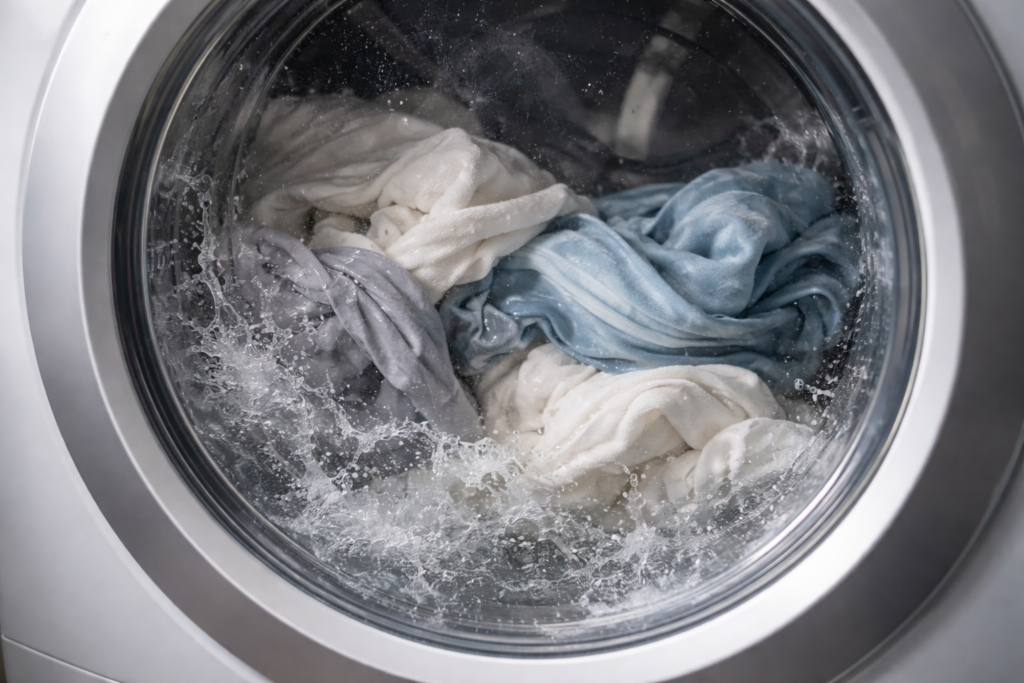
Washing machines are dynamic systems. Water temperature changes throughout the cycle. Fabrics absorb heat. Cold water is introduced during rinsing. Loads shift, fold, and compress.
Because of this:
- Heat is not evenly distributed across all fabrics
- Temperature is not maintained long enough for defined sanitization thresholds
- Dense or layered items receive less direct exposure
Even when a wash cycle begins with hot water, the effective temperature drops quickly as the system runs.
Temperature limits in home laundry systems
Many people search for a specific number that guarantees sanitization. Household washers rarely maintain temperatures high enough, long enough, and consistently enough to meet those expectations.
Higher temperatures also introduce tradeoffs:
- Accelerated fiber breakdown
- Shrinkage and color loss
- Reduced lifespan of elastic and synthetic materials
- Increased energy use
For most household laundry, temperature alone is an inefficient and imprecise control.
The role of detergents and mechanical action
Cleaning effectiveness is driven by interaction, not heat alone. Detergents are formulated to loosen oils, residues, and soils so they can be carried away in water. Mechanical action and adequate rinsing determine whether those materials actually leave the fabric.
When residues and moisture are removed effectively, many hygiene concerns resolve without relying on extreme temperatures.
Why dryers are often misunderstood
Dryers are frequently assumed to finish what washing started. In reality, their primary contribution is moisture removal.
Drying effectiveness depends on:
- Load size and airflow
- Fabric thickness and density
- Whether items are fully dried or removed while still warm and damp
Removing moisture reduces odor development and supports fabric stability, but it does not guarantee sanitization.
Cleaning, odor control, and sanitizing are not the same outcome
Laundry that smells fresh is not necessarily sanitized. Laundry that is sanitized may still hold residue if rinsing and drying are poor.
In everyday use:
- Cleaning removes soils and residues
- Odor control depends on moisture management
- Sanitizing requires specific, controlled conditions
Most household laundry routines are designed for cleaning and moisture control, not formal sanitization.
When hot water is useful
Hot water can support laundry outcomes in certain situations:
- Heavy soil loads
- Oil based residues on sturdy fabrics
- Items that tolerate higher temperatures without damage
Its value comes from assisting detergent performance, not from acting as a standalone solution.
Understanding sanitize settings on machines
Some washers include sanitize cycles. These differ from standard hot washes by increasing temperature, extending cycle time, and adjusting water use. Results still depend on load size, fabric type, and proper use.
These cycles are engineered compromises, not equivalents to commercial or institutional processes.
Practical hygiene without relying on heat myths
Household laundry hygiene is supported by:
- Appropriate detergent dosing
- Adequate rinsing
- Load sizes that allow movement and airflow
- Complete drying between uses
Hot water can be part of that system, but it is not the deciding factor.
Hot water does not automatically sanitize laundry. It contributes to cleaning under certain conditions, but true sanitization requires more control than most home systems provide. Understanding those limits leads to better habits, fewer assumptions, and longer lasting fabrics.