How Much Detergent Is Too Much A Practical Guide
Most people do not intentionally overuse detergent. It usually starts as a small adjustment. Clothes do not smell as fresh as expected, so a little extra is added next time. A load feels stiff, so another rinse is run. Over time, the habit becomes normal.
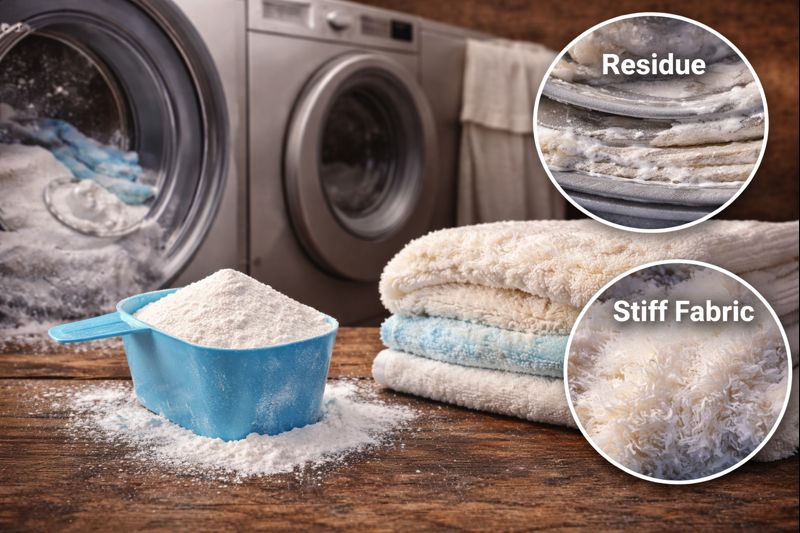
The problem is that more detergent does not automatically mean more cleaning. In many cases, it does the opposite.
Why more detergent can lead to worse results
Laundry cleaning works in stages. Detergent loosens soil. Water carries that soil away. Rinsing removes what is left behind.
When too much detergent is used, that balance breaks.
- Extra detergent creates more residue than the rinse cycle can remove
- Leftover detergent stays trapped in fabric fibers
- That residue attracts soil and moisture after washing
Instead of leaving clothes cleaner, overdosing leaves behind material that causes stiffness, dullness, and lingering odor.
Why modern washing machines make overdosing easier
Older washing machines used large volumes of water. Extra detergent was more likely to rinse away simply because there was more water moving through the load.
Modern machines are designed to use less water. This improves efficiency, but it also means:
- There is less water available to rinse excess detergent
- Concentrated formulas are harder to dilute fully
- Residue builds up faster if dosing is not adjusted
This is why people often notice overdosing problems after switching machines, even if they did not change detergent brands.
What detergent residue actually feels like
People often describe detergent residue without realizing what it is.
Common signs include:
- Clothes that feel stiff or crunchy when dry
- Towels that repel water instead of absorbing it
- Fabric that smells clean at first, then smells off after wearing
- A slick or waxy feeling on darker fabrics
These are not signs that clothes are dirty. They are signs that detergent was not fully rinsed away.
Why adding more detergent does not fix odor
One of the most common misconceptions is that odor means not enough detergent was used.
In reality, lingering odor often comes from:
- Detergent residue trapping moisture
- Residue binding with body oils over time
- Incomplete rinsing allowing buildup to remain
Adding more detergent increases residue, which makes odor problems worse rather than better.
How soil level actually affects detergent needs
Heavily soiled clothes do sometimes require more cleaning power, but that does not always mean more detergent.
Factors that matter more than quantity:
- Water temperature
- Load size relative to drum capacity
- How evenly clothes are distributed
- Whether the detergent formula is designed to rinse clean
In many cases, improving wash conditions works better than increasing detergent amount.
How to tell if you are using too much detergent
You may be overdosing if:
- Clothes feel stiff even when air dried
- Towels lose absorbency over time
- You frequently need extra rinse cycles
- Your washer develops buildup or odor
These are system signals, not personal mistakes.
Why detergent type changes dosing expectations
Not all detergents behave the same way.
Many mainstream detergents rely on ingredients that suspend soil in water. If too much is used, those ingredients stay behind when rinsing is limited.
Detergents formulated with fewer ingredients and controlled alkalinity tend to:
- Require smaller amounts
- Rinse more completely
- Reduce the need for correction steps
This is why following the label for one detergent does not always translate well to another.
How The G Spot Detergent approaches dosing differently
The G Spot Detergent is formulated to clean using baking soda and super washing soda as core ingredients, without relying on surfactants or synthetic fillers.
Because of this approach:
- Cleaning power comes from balanced alkalinity rather than volume
- Smaller amounts are effective
- Rinsing is prioritized to avoid buildup
In systems like this, adding more detergent does not improve results. It only disrupts balance.
The practical takeaway
If clothes are not coming out the way you expect, the answer is rarely to add more detergent.
Better results usually come from:
- Using less detergent than you think you need
- Letting the rinse cycle do its job
- Choosing formulas designed to rinse cleanly
Laundry works best when the system is balanced, not overloaded.