Baking Soda vs Washing Soda in Laundry What’s the Difference
When people ask whether baking soda or washing soda is better for laundry, they are usually responding to a problem they can feel. Clothes that smell clean at first but develop odors later. Whites that look dull. Towels that feel stiff or coated. Detergent that no longer seems to rinse well. These issues are rarely about one single ingredient failing. They are usually about how the entire wash system is working together.
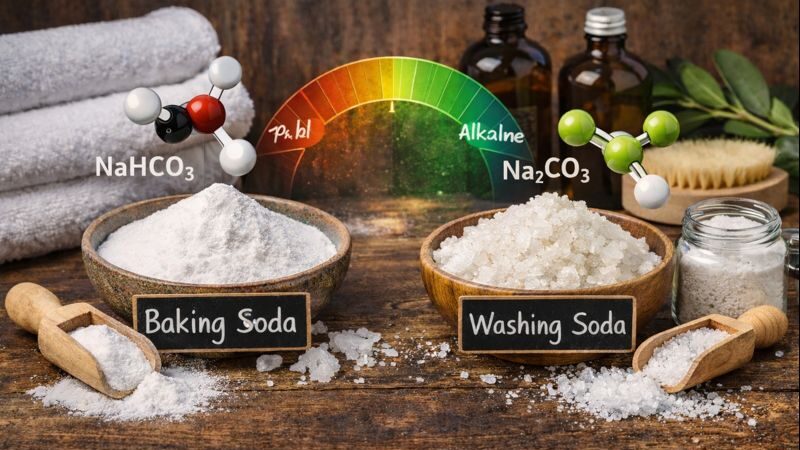
Baking soda and washing soda are closely related, but they behave very differently in laundry. Understanding that difference helps explain why one may help in certain situations, why the other can cause problems if misused, and why some detergent formulas use both intentionally.
What baking soda and washing soda actually are
Both ingredients are sodium based compounds, but they are not interchangeable.
- Baking soda is sodium bicarbonate
- Washing soda is sodium carbonate
Washing soda is made by heating baking soda, which removes carbon dioxide and water. That process increases alkalinity. This single change explains nearly every performance difference between the two.
Why alkalinity matters in laundry systems
Laundry does not clean by scrubbing. It cleans through chemistry and movement working together. Alkalinity affects how water:
- Loosens oily soils from fabric
- Interacts with minerals like calcium and magnesium
- Supports or interferes with cleaning ingredients
Too little alkalinity can limit soil removal. Too much can contribute to stiffness, fading, or residue when rinsing is incomplete. Effective laundry depends on balance, not maximum strength.
How baking soda behaves in laundry
Baking soda is mildly alkaline and works as a support ingredient rather than a primary cleaner.
Baking soda can:
- Neutralize acidic odors instead of masking them
- Help stabilize wash water conditions
- Provide light support in mildly hard water
Baking soda does not:
- Break down greasy soils on its own
- Replace detergent
- Correct heavy mineral interference
This explains why baking soda often helps with odor related issues but falls short when soil, buildup, or hard water are the real problem.
How washing soda behaves differently
Washing soda is strongly alkaline and functions as a builder. Builders change the washing environment so cleaning can happen more effectively.
Washing soda can:
- Raise alkalinity enough to break down greasy soils
- Bind minerals that interfere with cleaning
- Improve performance in hard water
- Help reverse dullness caused by mineral buildup
Because it is stronger, washing soda requires more attention to dosage and rinsing. Overuse can leave fabrics stiff or contribute to color fading, especially in modern low water machines.
This is why washing soda is sometimes described as harsh. The issue is not the ingredient itself, but how it is used.
Can baking soda replace washing soda
These two ingredients are not direct substitutes.
- Baking soda cannot replace washing soda when mineral binding or grease breakdown is needed
- Washing soda does not perform the same odor neutralizing role as baking soda
Using one in place of the other often leads to disappointment because the ingredient is being asked to do a job it was not designed to do.
Is washing soda safe for clothes and machines
When used appropriately, washing soda is compatible with fabrics and washing machines.
Problems tend to occur when:
- Too much is added
- It is layered on top of already concentrated detergent
- Rinsing is insufficient
Modern washers use less water than older machines. That makes restraint and proper formulation more important than it used to be.
How baking soda and washing soda are used in many commercial detergents
In many mainstream detergents, baking soda and washing soda are added as supporting ingredients within formulas that rely heavily on synthetic surfactants. In those systems, these ingredients are often compensating for other formulation choices.
In those formulas:
- Washing soda is commonly used to offset hard water so surfactants can work more efficiently
- Baking soda is often included to manage odor when residue builds up
- Performance depends heavily on how well the system rinses
When residue accumulates, people often add more baking soda or washing soda to fix the issue. In reality, that response usually points to imbalance elsewhere in the detergent system rather than a lack of cleaning power.
How The G Spot Detergent uses baking soda and super washing soda
The G Spot Detergent intentionally uses baking soda and super washing soda as core functional ingredients, not as add ons or afterthoughts.
Our formulas do not rely on surfactants, synthetic fillers, or masking agents. Cleaning performance is built around controlled alkalinity, mineral interaction, and rinse clarity.
In this approach:
- Baking soda supports odor neutralization and wash stability
- Super washing soda provides the alkalinity needed to address soil and mineral interference
- Both ingredients are selected for purity and function rather than brand recognition
Because these ingredients are integrated intentionally and proportionally, they are not compensating for other components. They are doing the work they are meant to do within a balanced system.
This is also why adding extra baking soda or washing soda on top of a well balanced formula is usually unnecessary. When alkalinity and mineral handling are already accounted for, more does not mean better.
Why sourcing and formulation matter more than ingredient names
Two products can list baking soda or washing soda and behave very differently in real laundry use. Differences often come from:
- Ingredient grade and purity
- How alkalinity is balanced across the formula
- How well the system rinses in low water machines
Ingredient names alone do not tell the full story. How those ingredients are used matters more than whether they appear on a label.
How this ties back to choosing between baking soda and washing soda
Understanding the difference between baking soda and washing soda helps clarify why neither is universally better.
Each ingredient has a defined role:
- Baking soda supports odor management and mild water variability
- Super washing soda addresses alkalinity and mineral challenges
When those roles are respected and balanced within the detergent itself, laundry performance improves without the need for correction steps later.